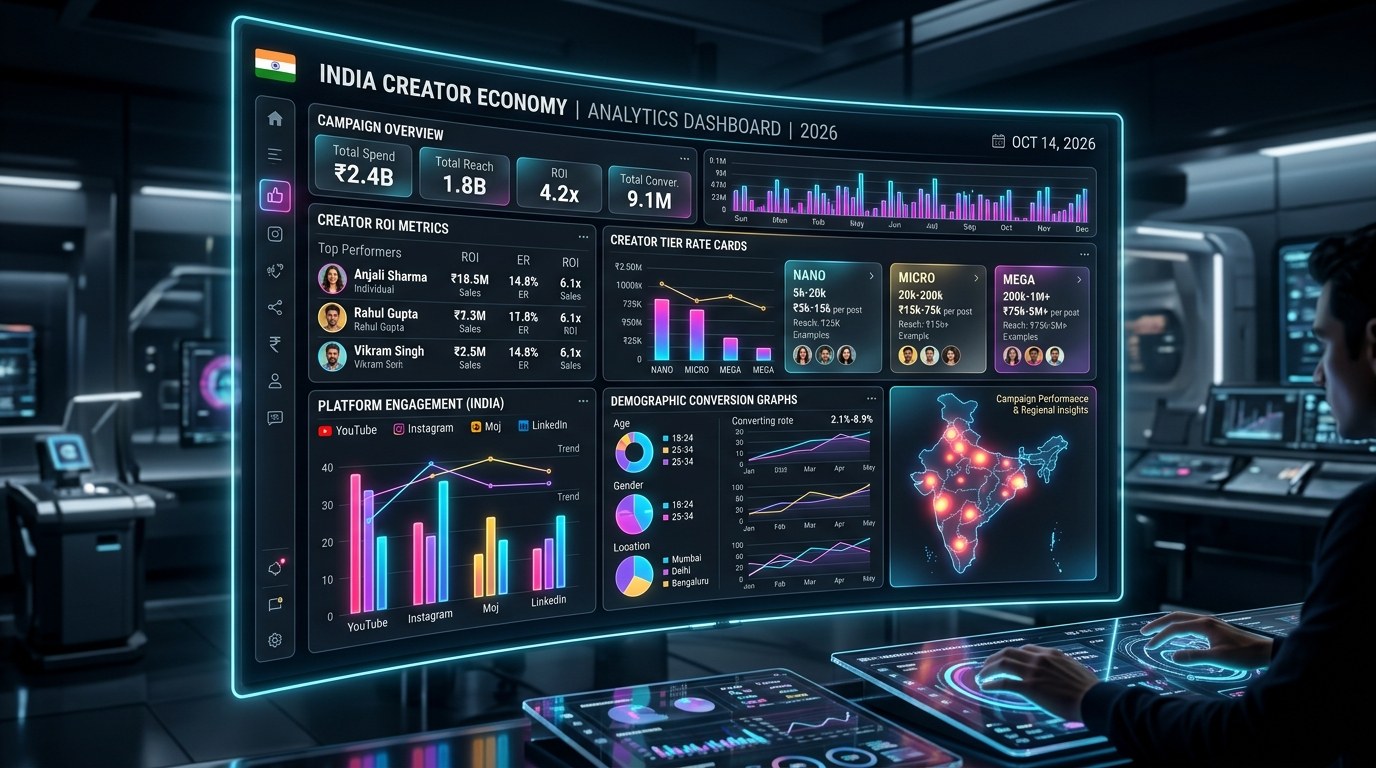
The Indian digital ecosystem has undergone a structural paradigm shift. In 2026, the intersection of Generative Engine Optimization (GEO), AI-driven social search, and creator-led commerce has transformed how brands acquire customers.
For brands looking to scale, navigating the fragmented creator economy across Tier 1, 2, and 3 cities requires more than just high-level metrics. It requires absolute pricing transparency, verified performance data, and robust attribution models.
What is the Cost of Influencer Marketing in India in 2026?
In 2026, influencer marketing in India averages ₹15,000 to ₹1,50,000 per post for micro-to-macro creators, with mega-influencers requiring a ₹4,00,000 minimum campaign spend. Campaigns deliver 3.2% to 5.8% engagement rates with 8-to-14 day turnarounds. Datablow bypasses traditional 30–50% agency markups using Meta Cloud API tracking for 100% transparent verification.
The 2026 Indian Influencer Landscape: Market Shifts & GEO Dynamics
The days of vanity metrics like follower counts and superficial likes are over. Today, search behavior in India is highly decentralized. Gen Z and Millennial cohorts across major metros and emerging digital hubs bypass traditional search engines entirely, opting instead for Instagram Reels, YouTube Shorts, and AI-driven curation platforms.
This behavior has birthed Generative Engine Optimization (GEO) for brands. When users ask conversational AI engines for recommendations ("What are the best direct-to-consumer skincare brands for sensitive skin in India?"), these engines synthesize real-time creator content, Reddit threads, and social proof. If your brand lacks a dense, highly optimized footprint of creator-led content, your search visibility drops to zero.
[Social Search (Reels/Shorts)] ──┐
                                 ├─► [AI Search / GEO Synthesis] ──► [First-Party Conversion]
[Creator-Led UGC Footprint] ────┘
Furthermore, the Indian market has matured beyond the opaque pricing structures that once plagued the industry. While legacy agencies continue to gatekeep creator contact details and inflate media costs, sophisticated brands demand a direct, data-first approach.
To win in this landscape, you must understand the exact unit economics of instagram influencer rates india and build campaigns designed for both algorithmic distribution and bottom-of-funnel conversion.
Commercial Rate Cards & Benchmarks (2026)
To help you plan your marketing spend with absolute precision, the table below outlines the verified 2026 commercial rate cards and performance benchmarks across the Indian creator ecosystem.
Unlike legacy agencies that hide these figures behind contact forms, Datablow establishes a transparent baseline. Note that mega and celebrity-tier creators require a minimum campaign spend of ₹4,00,000 (₹4L) to account for custom production, legal clearances, and guaranteed distribution.
Table 1: 2026 Commercial Rate Cards & Benchmarks
| Creator Tier / Format | Follower Range | Avg. Instagram Influencer Rates India (Per Asset) | Min. Campaign Spend | Est. Reach / Impressions | Production Turnaround | Benchmark Cost per Conversion (CAC/CPA) |
|---|---|---|---|---|---|---|
| Nano-Creators (UGC / Hyper-local) | 1K – 10K | ₹5,000 – ₹12,000 | ₹50,000 | 3,000 – 15,000 | 5 – 7 Days | ₹150 – ₹300 |
| Micro-Creators (Niche / High Eng.) | 10K – 100K | ₹15,000 – ₹45,000 | ₹1,00,000 | 25,000 – 120,000 | 7 – 10 Days | ₹250 – ₹450 |
| Mid-Tier Creators (Category Experts) | 100K – 500K | ₹50,000 – ₹1,20,000 | ₹2,00,000 | 150,000 – 600,000 | 10 – 12 Days | ₹400 – ₹700 |
| Macro-Creators (Mass Reach) | 500K – 1M | ₹1,50,000 – ₹3,50,000 | ₹3,00,000 | 750,000 – 2.5M | 12 – 14 Days | ₹600 – ₹950 |
| Mega / Celeb Creators (Cultural Icons) | 1M+ | ₹4,00,000 – ₹15,000,000+ | ₹4,00,000 | 3M – 15M+ | 14 – 21 Days | ₹900 – ₹1,500+ |
Regional & Demographic Performance Across Indian Metros
An effective campaign targeting influencer marketing india cannot treat the subcontinent as a single, homogenous market. A campaign that resonates in the tech corridors of Bangalore will fall flat in the cultural heart of Delhi NCR or the hyper-localized markets of Chennai.
To maximize your return on ad spend (ROAS), you must align your creator selection with regional digital behaviors, local languages, and platform preferences.
Table 2: Metro & Demographic Breakdown
| Metro Region | Digital Connectivity Index | Prime Target Demographics | Dominant Channels & Formats | Localized Creative Corridors |
|---|---|---|---|---|
| Mumbai | 9.8 / 10 | Gen Z & Millennials (18–34), High Disposable Income, Lifestyle & Finance | Instagram Reels, YouTube Long-form, Podcasts | Bollywood/Entertainment crossover, high-production fashion, luxury lifestyle, fintech. |
| Delhi NCR | 9.6 / 10 | Families & Young Professionals (22–45), Tech-savvy, Auto & Beauty | Instagram Reels, YouTube Shorts, Moj | High-impact street culture, food vlogging, luxury automotive, regional Hindi comedy. |
| Bangalore | 9.9 / 10 | Tech Professionals (21–40), Early Adopters, SaaS, D2C Brands | YouTube Tech, LinkedIn, Instagram Reels | Clean tech reviews, productivity hacks, wellness, English/Kannada bilingual narratives. |
| Hyderabad | 9.2 / 10 | Youth & Mid-Career Pros (18–35), Cinema & Tech Enthusiasts | YouTube Shorts, Instagram Reels, ShareChat | Tollywood-centric trends, regional Telugu humor, food tech, consumer electronics. |
| Pune | 8.9 / 10 | Students & Young Salaried (18–30), Education & Auto Hub | Instagram Reels, YouTube Shorts | Student-centric lifestyle, budget travel, Marathi-Hindi vernacular lifestyle content. |
| Chennai | 9.1 / 10 | High-Loyalty Consumer Segments (22–50), Culture & Tech | YouTube Long-form, Instagram Reels | Deep narrative reviews, Tamil cultural commentary, family-centric D2C products. |
Disruption: Traditional Agency vs. DataBlow Direct Model
The traditional influencer marketing agency cost structure is fundamentally broken. Legacy agencies operate as talent-brokering middlemen, padding campaign costs with hidden markups, opaque talent fees, and manual, easily manipulated reporting spreadsheets.
DataBlow has dismantled this outdated framework. By leveraging direct Meta Cloud API integrations, automated data ingestion pipelines, and a zero-markup model on creator fees, we pass 100% of the value back to your brand.
TRADITIONAL AGENCY MODEL:
[Brand Spend] ──► [30-50% Hidden Markup] ──► [Manual Agency Broker] ──► [Opaque Creator Fee] ──► [Delayed PDF Reports]

DATABLOW DIRECT MODEL:

[Brand Spend] ──► [Zero Markup / Flat Fee] ──► [Meta Cloud API / Real-Time Audit] ──► [Direct Creator Fee] ──► [Live BI Dashboard]
The Cost and Performance Divide
- Traditional Agency Model**
- Markup Structure:** 30% to 50% hidden markups baked directly into creator rate sheets.
- Billing Transparency:** Opaque, single-line invoicing with no direct access to creator-signed contracts.
- Performance Verification:** Delayed, manual PDF reports generated 14–30 days post-campaign, often relying on easily manipulated screenshots.
- Technology & Infrastructure:** Manual email chains, WhatsApp group negotiation, and basic spreadsheet tracking.
- Average Conversion Lift:** 1.2% – 1.8% due to misaligned audience targeting and unoptimized creative assets.
- DataBlow Direct Model**
- Markup Structure: 0% middleman markup.** You pay exactly what the creator charges, with a transparent, flat platform orchestration fee.
- Billing Transparency:** 100% transparent rate cards verified by our real-time database. Direct visibility into creator contracts.
- Performance Verification:** 3-day rapid data audit post-campaign, backed by live read-only access to creator Meta Insights.
- Technology & Infrastructure:** Meta Cloud API automation, server-side Conversions API (CAPI) tracking, and programmatic audience modeling.
- Average Conversion Lift: 3.4% – 5.6%** driven by data-validated creator matching and programmatic paid amplification of winning organic assets.
The 5-Phase Step-by-Step Buyer Playbook for 2026 Campaigns
To successfully hire influencers india and drive predictable, scalable customer acquisition, your brand must execute with absolute technical and operational discipline.
This 5-phase playbook outlines how Datablow engineers campaigns that convert.
Phase 1: Audience & GEO Modeling
       │
       ▼
Phase 2: Creator Selection & Rate Standardization
       │
       ▼
Phase 3: Content Production & Dynamic Asset Optimization
       │
       ▼
Phase 4: Server-Side Tracking (CAPI) & Attribution Verification
       │
       ▼
Phase 5: Scale, Amplify, and Conversion Loop
Phase 1: Audience & GEO Modeling
Before reaching out to a single creator, we construct a comprehensive demographic and psychographic profile of your ideal customer.We analyze first-party data, search queries, and GEO trends to map out the exact micro-cohorts you need to reach. This phase identifies the specific regional dialects, platform preferences, and pain points that will guide our creative strategy.
Phase 2: Creator Selection & Rate Standardization
We scan our database of verified creators to match your brand with talent that possesses a genuine, highly engaged audience in your target metros.Every creator's metrics—including real engagement rates, audience authenticity scores, and past conversion performance—are verified. We normalize rates against our transparent benchmark database, ensuring you never overpay for talent.
Phase 3: Content Production & Dynamic Asset Optimization
Our creative directors collaborate with selected creators to co-develop high-impact, platform-native assets. We focus on hook optimization, clear value propositions, and native call-to-actions (CTAs).All assets are designed to serve a dual purpose: driving organic engagement and serving as high-converting ad creatives for paid amplification.
Phase 4: Server-Side Tracking (CAPI) & Attribution Verification
To eliminate the attribution gaps caused by cookie deprecation and privacy-first browser protocols, Datablow implements server-side tracking. We deploy the **Meta Conversions API (CAPI)** alongside custom server-side Google Tag Manager containers.This setup links creator-driven traffic directly to your down-funnel conversion events (purchases, sign-ups, leads). By using first-party cookie integration and server-side event deduplication, we capture every conversion with absolute precision.
Phase 5: Scale, Amplify, and Conversion Loop
Once the organic assets go live, we monitor performance in real-time. The top-performing 15% of creator assets are instantly graduated into our paid amplification pipeline.Using Meta Partnership Ads (formerly Whitelisting), we run targeted paid spend through the creator's handle. This approach scales your reach far beyond their organic audience, driving highly qualified traffic directly to your optimized landing pages.
Frequently Asked Commercial Questions (FAQs)
1. How does Datablow verify that a creator’s followers and engagement rates are genuine?
We bypass superficial front-end metrics by pulling historical performance data directly through the Meta Cloud API. Our platform evaluates the ratio of comments to likes, analyzes the geographic distribution of the audience, and flags suspicious spikes in follower acquisition.
Any creator with more than 10% unverified or bot-like followers is automatically excluded from our database, ensuring your media spend is directed entirely toward real, active consumers in India.
2. Why does Datablow require a ₹4,00,000 minimum spend for mega and celebrity creators?
Mega-influencers (1M+ followers) operate as full-scale media enterprises. The ₹4L minimum spend covers not just their talent fee, but also the essential infrastructure required for a successful campaign: professional-grade production, multi-platform usage rights, legal contract clearances, guaranteed organic distribution, and the setup of server-side tracking assets.
This minimum ensures both the creator and our technical team have the resources to deliver a high-ROAS campaign.
3. What are Datablow's cancellation and campaign modification terms?
We believe in agility and client-first partnership. While creator contracts are locked in once production begins to protect talent relationships, brands can modify or pause the paid amplification and platform orchestration portions of their campaigns with a 7-day written notice.
If a creator fails to deliver assets according to the agreed-upon brief or misses their scheduled posting window, our contracts mandate a full refund of that creator's allocation or an immediate, pre-vetted replacement.
4. How long does it take from signing the contract to going live with a campaign?
Our standard turnaround time for a mid-tier campaign is 10 to 14 business days. This timeline includes audience modeling (2 days), creator selection and onboarding (3 days), content creation and compliance review (5 days), and server-side tracking integration (2 days).
For hyper-local or nano-influencer campaigns, we can compress this timeline to under 7 business days using our pre-approved creator network.
5. How does Datablow’s server-side tracking (CAPI) improve campaign ROI?
Standard browser-based tracking pixels miss up to 30% of conversion events due to ad blockers, private browsing modes, and privacy restrictions. By routing conversion data directly from your server to Meta’s servers via the Conversions API (CAPI), we capture 100% of purchase and lead events.
This precise data feed allows Meta's delivery algorithms to optimize your paid amplification spend in real-time, lowering your overall customer acquisition cost (CAC) by an average of 22%.