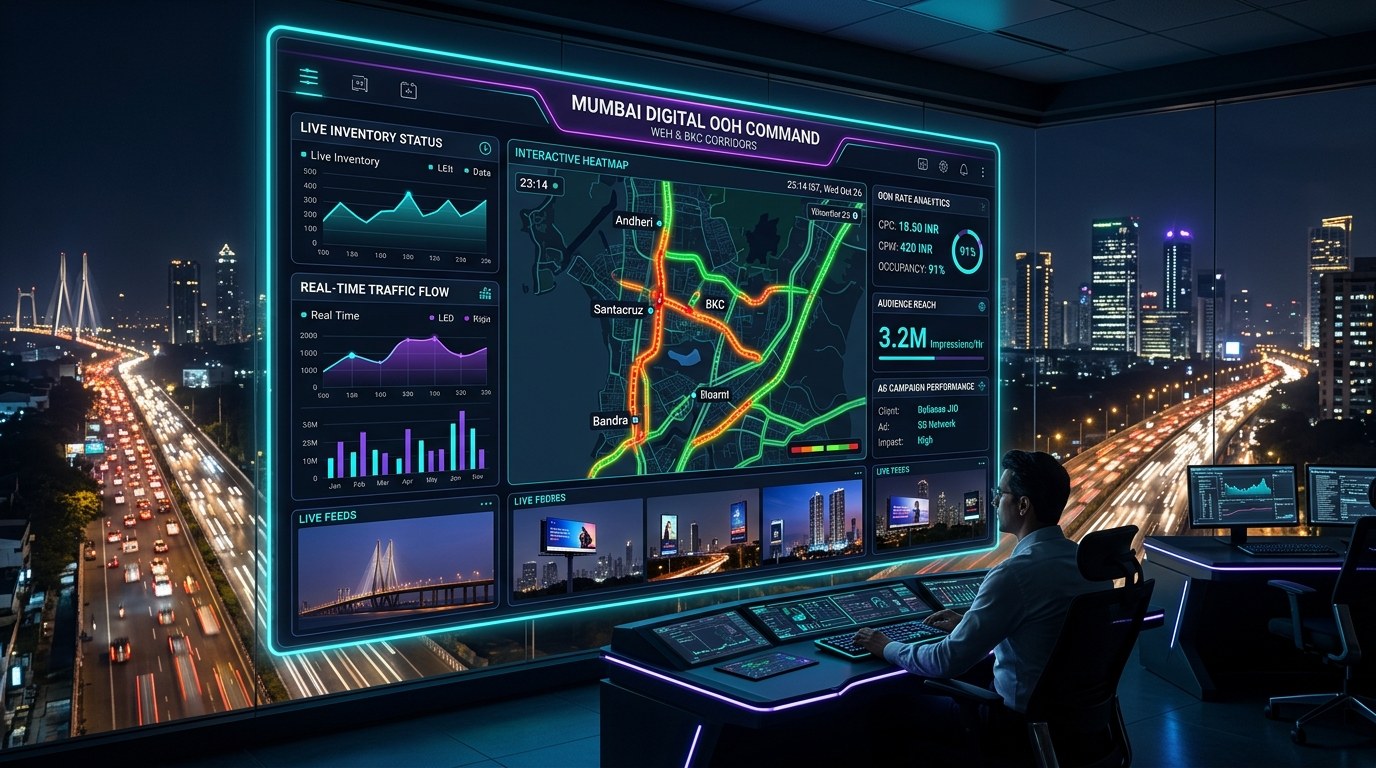
Mumbai’s high-density urban topography, long commute times, and immense wealth concentration make it the most lucrative yet commercially complex Out-of-Home (OOH) advertising market in India. As infrastructure projects like the Mumbai Coastal Road, Metro Line 3, and the Atal Setu Trans-Harbour Link redefine commuter paths, the spatial dynamics of outdoor media have shifted. For brands targeting high-net-worth individuals (HNIs), corporate decision-makers, or mass consumer segments, navigating this landscape requires a transition from legacy buying models to data-driven, programmatic, and verified media planning.
Traditional media buying in the city has historically been plagued by opaque pricing, multi-tiered agency markups, and unverified post-campaign reporting. To counter these inefficiencies, modern enterprises are shifting toward algorithmic planning. By leveraging real-time traffic telemetry, mobile SDK location data, and unified programmatic platforms, brands can optimize their ad spend and achieve measurable conversion lifts across the city’s most competitive transit corridors.
Navigating the Mumbai Billboard Advertising Landscape
Premium billboard advertising in Mumbai ranges from ₹1.5 Lakh to ₹25 Lakh per month depending on the location. Prime zones like Bandra and BKC deliver 5M+ weekly impressions. Campaigns can be planned, verified, and deployed in under 3 to 7 days using DataBlow’s transparent programmatic booking platform.
The Mumbai OOH market is governed by strict spatial economics. Unlike other metros where space is abundant, Mumbai's linear geography forces traffic through highly congested north-south arterial bottlenecks. This structural reality creates premium "choke points" where commuter dwell times are exceptionally high, driving up the value of surrounding media assets.
Following recent regulatory updates by the Brihanmumbai Municipal Corporation (BMC)—which mandate rigorous structural stability audits, wind-load certifications, and strict illumination window guidelines—the market has experienced a flight to quality. Illegal or structurally compromised hoardings have been systematically dismantled, leaving a premium, highly compliant inventory of static and digital billboards. For brands, this regulatory cleanup ensures that every rupee spent on billboard advertising mumbai campaigns goes toward legally secure, high-visibility assets that protect and elevate brand equity.
Mumbai's High-Value Transit Corridors: WEH, Bandra, and BKC
To maximize return on ad spend (ROAS), media buyers must match their target audience demographics with the unique traffic profiles of Mumbai's primary transit corridors.
[North Mumbai / Suburbs]
         │
         ▼
 ┌───────────────┐
 │   WEH Hub     │  ◄── Mass Premium & Daily Commuters (2.5M+ Daily Footfall)
 └───────┬───────┘
         │
         ├────────────────────────┐
         ▼                        ▼
 ┌───────────────┐        ┌───────────────┐
 │  Bandra Zone  │        │    BKC Hub    │
 │ (HNIs & Gen Z)│        │ (B2B/Finance) │
 └───────┬───────┘        └───────┬───────┘
         │                        │
         └───────────┬────────────┘
                     ▼
             [South Mumbai / Island City]
Western Express Highway (WEH)
Spanning from Dahisar to Bandra, the Western Express Highway is the busiest arterial road in Mumbai, carrying over 2.5 million vehicles daily. The corridor serves as a daily transit route for corporate professionals commuting from residential hubs in the north to commercial districts in the south. * **Demographic Profile:** Mid-to-high-income families, corporate executives, dual-income households, and daily commuters. * **Key Choke Points:** The Andheri flyover bypass, Goregaon Hub Mall junction, and the Kalanagar junction bottleneck. * **Media Formats:** Large-format static hoardings, backlit gantries, and high-impact digital LED screens at major flyover exits. * **Strategic Value:** High frequency and consistent daily reach. The slow-moving bumper-to-bumper traffic during morning and evening peak hours guarantees extended dwell times, making it ideal for high-impact brand awareness and product launches.Bandra (SVT, Reclamation, and Linking Road)
Bandra is the undisputed cultural and commercial gateway of Mumbai, connecting the Western Suburbs to South Mumbai via the Bandra-Worli Sea Link. It is a high-visibility zone characterized by affluent residents, premium retail hubs, and a vibrant dining and nightlife scene. * **Demographic Profile:** HNIs, Bollywood tastemakers, affluent Gen Z and Millennial shoppers, and premium lifestyle consumers. * **Key Choke Points:** Bandra Reclamation Toll Plaza, SV Road intersections, and the turn-offs toward Linking Road. * **Media Formats:** Iconic, ultra-large static hoardings, premium digital billboards, and architectural wraps. * **Strategic Value:** Unmatched prestige and high-impact visual dominance. Placing an asset at Bandra Reclamation ensures exposure to affluent commuters entering or exiting the Sea Link, making it a critical site for luxury, real estate, and premium consumer tech brands.Bandra-Kurla Complex (BKC)
As Mumbai's premier central business district, BKC houses global financial institutions, multinational headquarters, consulate offices, and luxury retail developments like the Jio World Plaza. * **Demographic Profile:** C-suite executives, investment bankers, tech leaders, expat communities, and high-earning corporate professionals. * **Key Choke Points:** Kalanagar entry point, Bharat Diamond Bourse junction, and the main avenues leading to the MCA Club. * **Media Formats:** Programmatic **digital billboards mumbai** networks, high-definition smart kiosks, and premium corporate-facing static hoardings. * **Strategic Value:** High-intent B2B targeting. BKC is the ideal environment for SaaS providers, wealth management services, luxury automotive brands, and enterprise-grade solutions looking to capture the attention of key corporate decision-makers during their business day.2026 Commercial Rate Cards and Media Benchmarks
Understanding the baseline costs and performance metrics of various media formats is essential for realistic budget allocation. The table below outlines the projected 2026 commercial rate cards for premium OOH and DOOH formats across Mumbai.
Table 1: 2026 Mumbai OOH/DOOH Commercial Rate Cards & Benchmarks
| Media Format / Tier | Prime Locations | Monthly Rate Range (INR) | Est. Monthly Impressions | Min. Campaign Duration | Production & Mounting Cost (INR) | Est. CPM Range (INR) |
|---|---|---|---|---|---|---|
| Super-Premium Static Hoarding | Bandra Reclamation, Sea Link Exit, BKC Entry | ₹12,00,000 – ₹25,00,000 | 4.5M – 7.0M | 30 Days | ₹1,50,000 – ₹2,50,000 | ₹250 – ₹350 |
| Premium Static Hoarding (Tier 1) | WEH (Andheri, Bandra Flyover), Juhu, Pedder Road | ₹6,00,000 – ₹12,00,000 | 3.0M – 4.5M | 30 Days | ₹1,00,000 – ₹1,80,000 | ₹200 – ₹270 |
| Standard Static Hoarding (Tier 2) | EEH (Ghatkopar, Mulund), JVLR, Link Road | ₹2,50,000 – ₹6,00,000 | 1.8M – 3.0M | 30 Days | ₹75,000 – ₹1,20,000 | ₹140 – ₹200 |
| Programmatic DOOH (High-Def LED) | BKC Corporate Hub, Lower Parel (Senapati Bapat Marg) | ₹3,50,000 – ₹8,00,000 | 2.5M – 4.0M | 7 Days (Flexible) | Digital Delivery (Nil) | ₹120 – ₹180 |
| Transit Media (Metro Wraps / Station OOH) | Metro Line 1 (Versova-Andheri-Ghatkopar), Line 3 | ₹4,00,000 – ₹10,00,000 | 3.5M – 5.5M | 30 Days | ₹2,00,000 – ₹4,00,000 | ₹110 – ₹180 |
| Bespoke Unipoles & Gantries | Airport Approach Road, Western Express Highway | ₹5,00,000 – ₹9,50,000 | 2.2M – 3.5M | 30 Days | ₹90,000 – ₹1,50,000 | ₹180 – ₹250 |
Note: Actual rates may fluctuate based on seasonal demand (e.g., the Q3-Q4 festive surge), specific site angles, illumination levels, and multi-month commitment discounts.
National Cross-Metro OOH & Demographic Comparison
To help multi-city brands allocate their regional budgets effectively, it is helpful to analyze how Mumbai's media landscape compares to other Tier-1 Indian metros.
Table 2: National Metro OOH & Demographic Matrix
| Metro Area | Footfall Index (1-10) | Primary Audience Demographics | Prime Corridors / Key Channels | Average CPM Range (INR) | Dominant Media Format |
|---|---|---|---|---|---|
| Mumbai | 9.8 | High-earning corporate professionals, HNIs, mass transit commuters, youth | WEH, Bandra Reclamation, BKC, SCLR, Coastal Road | ₹180 – ₹350 | Large-format backlit static & premium DOOH |
| Delhi NCR | 9.5 | Government officials, business owners, affluent suburbanites (Gurgaon/Noida) | DND Flyway, MG Road, Cyber City, Ring Road | ₹150 – ₹280 | Digital unipoles, metro pillar networks, billboards |
| Bangalore | 8.7 | Tech professionals, startup founders, Gen Z, high-income millennials | Outer Ring Road (ORR), Indiranagar, Hebbal Flyover | ₹130 – ₹240 | Programmatic DOOH, tech park media, gantries |
| Hyderabad | 8.2 | IT/Pharma professionals, real estate investors, regional shoppers | Hitec City, Gachibowli, Jubilee Hills, ORR | ₹110 – ₹210 | Neon-lit hoardings, digital kiosks, unipoles |
| Pune | 7.5 | IT professionals, manufacturing executives, large student population | Hinjewadi IT Park, Senapati Bapat Road, Koregaon Park | ₹95 – ₹180 | Standard static hoardings, bus shelter networks |
| Chennai | 7.2 | Industrialists, IT professionals, traditional family demographics | OMR (IT Corridor), Mount Road, Anna Nagar | ₹90 – ₹170 | Traditional static hoardings, gantry networks |
Traditional Agency Model vs. DataBlow Direct Model
The traditional OOH buying ecosystem is highly fragmented, often relying on multiple intermediaries that drive up costs and obscure performance metrics. The comparison below highlights the differences between legacy agency practices and DataBlow’s transparent, data-driven approach.
TRADITIONAL AGENCY MODEL:
[Client] ──► [Agency] ──► [Sub-Broker] ──► [Media Owner] ──► [Unverified Deployment]
(30-50% Markup, Opaque Pricing, Delayed/Manual Audits)

DATABLOW DIRECT MODEL:

[Client] ──► [DataBlow Platform] ──► [Media Owner] ──► [Live Verified Deployment]

              │ (100% Transparent, Real-Time Mobile Telemetry, Meta Cloud API)

              └───────────────────────────────────────────────► [Conversion Lift Tracking]
Traditional Agency Model
* **Hidden Markups:** Multiple layers of sub-brokers and agencies can inflate **hoarding rates mumbai** by 30% to 50% above the media owner's base cost. * **Opaque Billing:** Campaigns are often billed on flat, unverified estimates, with little clarity on actual uptime or illumination schedules. * **Delayed Verification:** Proof of play or mounting is typically delivered via manual, easily manipulated physical photographs, often weeks after the campaign goes live. * **Siloed Execution:** OOH campaigns run in isolation, disconnected from the brand's digital, social, and search advertising initiatives. * **Static Planning:** Media selection is based on legacy relationships or subjective "gut feel" rather than active traffic flow or demographic data.DataBlow Direct Model
* **Zero Middleman Markup:** Direct integration with primary media owners ensures clients access net-neutral, transparent rates with no hidden fees. * **100% Transparent Rate Cards:** Complete visibility into base media costs, municipal licensing fees, and production expenses. * **3-Day Data Audit:** Independent, third-party verification of site structural integrity, active visibility angles, and daily traffic patterns. * **Meta Cloud API Automation:** Seamless integration with digital channels. DataBlow uses anonymized mobile location data to trigger localized social and programmatic ads to users who have been exposed to specific physical billboards. * **Real-Time Telemetry:** Advanced footfall analytics and device ID graphing provide verifiable metrics on actual Opportunities to See (OTS) and physical conversion lift.Step-by-Step Buyer Playbook for Mumbai Billboard Campaigns
To execute a highly effective, measurable billboard campaign in Mumbai, brands can follow this structured, five-phase roadmap.
┌──────────────────────────┐
│ PHASE 1: Target Modeling │ ──► Define audience segments and map spatial hot-spots.
└────────────┬─────────────┘
             ▼
┌──────────────────────────┐
│  PHASE 2: Asset Selection│ ──► Analyze visibility, run data audits, secure direct rates.
└────────────┬─────────────┘
             ▼
┌──────────────────────────┐
│  PHASE 3: Deployment     │ ──► Execute structural audits, print/mount assets, verify live.
└────────────┬─────────────┘
             ▼
┌──────────────────────────┐
│  PHASE 4: Attribution    │ ──► Track footfall telemetry, link to Meta Cloud API.
└────────────┬─────────────┘
             ▼
┌──────────────────────────┐
│  PHASE 5: Optimization   │ ──► Adjust creative, scale top sites, retarget digitally.
└────────────┬─────────────┘
Phase 1: Demographic & Spatial Modeling
* **Action:** Define your target audience segments (e.g., B2B decision-makers, premium retail shoppers, or mass-market consumers). Use mobile SDK location data to map where these segments live, work, and travel. * **Deliverable:** A spatial heatmap of Mumbai highlighting the exact corridors and junctions with the highest concentration of your target audience.Phase 2: Media Asset Procurement & Creative Adaptation
* **Action:** Select the optimal mix of static and digital inventory along your identified corridors. Partner with a transparent **outdoor advertising agency mumbai** to secure direct, un-marked-up rates. Adapt your creative assets for high-speed, high-impact reading. * **Design Rule:** Keep copy under 7 words, use high-contrast color palettes, ensure the brand logo occupies at least 15% of the layout, and use bold, legible sans-serif typography.Phase 3: Production, Installation & Structural Audit
* **Action:** Oversee the high-resolution printing of vinyl substrates (front-lit or back-lit) or the formatting of digital files for LED screens. Conduct a pre-mounting physical and structural audit of the selected sites to ensure maximum visibility and safety compliance. * **Verification:** Demand geo-tagged, time-stamped photographic proof of installation within 4 hours of deployment, along with confirmation of the illumination schedule (typically 6:00 PM to 11:00 PM).Phase 4: Telemetry Integration & Multi-Channel Attribution
* **Action:** Deploy anonymized mobile device ID tracking around your active billboard locations. Establish virtual geofences around each site to log the unique devices entering the billboard's visual cone. * **Attribution:** Connect this exposure data to your digital marketing stack via the Meta Cloud API or Google Tag Manager (Server-Side). This allows you to track physical-to-digital conversion lift, website visits, and direct lead generation triggered by offline exposure.Phase 5: Performance Optimization & Re-engagement
* **Action:** Analyze weekly exposure and conversion reports. Shift budgets away from underperforming sites (e.g., locations with temporary traffic diversions or blocked visibility) and scale spend on high-yielding assets. * **Retargeting:** Deliver tailored digital ads (on social media, YouTube, or search networks) to users who were exposed to your physical billboards, reinforcing your brand message and driving them further down the sales funnel.Secure Your Premium Mumbai Billboard Campaign
Ready to elevate your brand’s physical footprint with transparent, data-verified OOH campaigns? Contact our media planning team to receive a custom, zero-markup rate card for Mumbai’s top corridors.- Direct Booking via WhatsApp:** +91 8247450006
- Corporate Inquiries via Email:** admin@datablow.com
- Onboarding Turnaround:** Custom media plans, site availability charts, and telemetry-backed reach projections are delivered within 48 hours of initial engagement.
Commercial Buyer FAQs
1. How does DataBlow verify actual impressions and prevent billing fraud?
DataBlow eliminates the guesswork of traditional OOH by utilizing anonymized mobile location data and SDK-based telemetry. We construct virtual geofences around each billboard site, mapping the exact visibility cone (accounting for angle, height, and read-distance). Every mobile device that enters this zone during active hours is logged as a verified Opportunity to See (OTS).
We cross-reference this data with real-time Google Maps traffic APIs and municipal vehicle-count databases. This multi-layered approach ensures you only pay for actual, verifiable human exposure, completely eliminating the inflated, static traffic estimates common in legacy agency reports.
2. What are the typical cancellation terms and flexibility policies for premium Mumbai hoardings?
Because premium billboard sites in high-demand zones like Bandra and BKC are highly competitive, cancellation terms vary by format: Static Hoardings: Standard contracts require a minimum 30-day non-cancellable period. Cancellations for subsequent months typically require written notice 15 to 30 days prior to the next billing cycle. Programmatic DOOH: These digital campaigns offer much greater flexibility. Brands can pause, modify, or reallocate digital budgets across different screens with as little as 48 hours' notice, making DOOH ideal for tactical promotions or rapid creative testing.
3. How do digital billboard (DOOH) slot rotations work in high-demand zones like BKC?
In premium commercial zones like BKC, digital billboards operate on a shared-loop model, also known as Share of Voice (SOV). A typical digital loop is 60 to 120 seconds long, divided into equal slots of 8 to 10 seconds.
Your brand’s ad runs once per loop, ensuring continuous, high-frequency exposure throughout the day. DataBlow also offers exclusive programmatic buying, allowing you to bid on and purchase specific high-traffic hours (e.g., morning and evening rush hours) to maximize your budget's impact.
4. What is the lead time required from contract signing to live asset deployment?
The deployment timeline depends largely on the media format you choose: Digital Billboards (DOOH): Can be launched almost instantly. Once your digital creative is approved and formatted, we can push the assets live to our connected screen network within 24 to 48 hours. Static Billboards: Require a lead time of 5 to 7 business days. This window covers high-resolution vinyl printing, structural safety checks, transport logistics, and overnight mounting by professional crew members.
5. How does DataBlow integrate OOH campaigns with digital retargeting?
DataBlow bridges the gap between physical and digital advertising through advanced device ID graphing. When a commuter enters the geofenced visibility cone of one of your active billboards, their anonymized mobile device ID is logged.
This exposure data is securely synced with your digital ad accounts (such as Meta, Google, and programmatic DSPs) via server-side APIs. As a result, you can automatically deliver tailored follow-up ads to those exact users on their mobile devices, significantly boosting overall conversion rates and maximizing your cross-channel ROI.